Second Brain
Everything you read, quietly connected.
A connected learning system that captures, organizes and brings back the right content at the right time, so that nothing you read gets lost.
Team 4 — Pranjay Tiwari · Rahul Khatav · Ridhima Kohli · Shreya Sivaram · Tanu Gupta
The problem
The biggest gap isn't finding content; it's getting value back from what's already saved.
The artefact
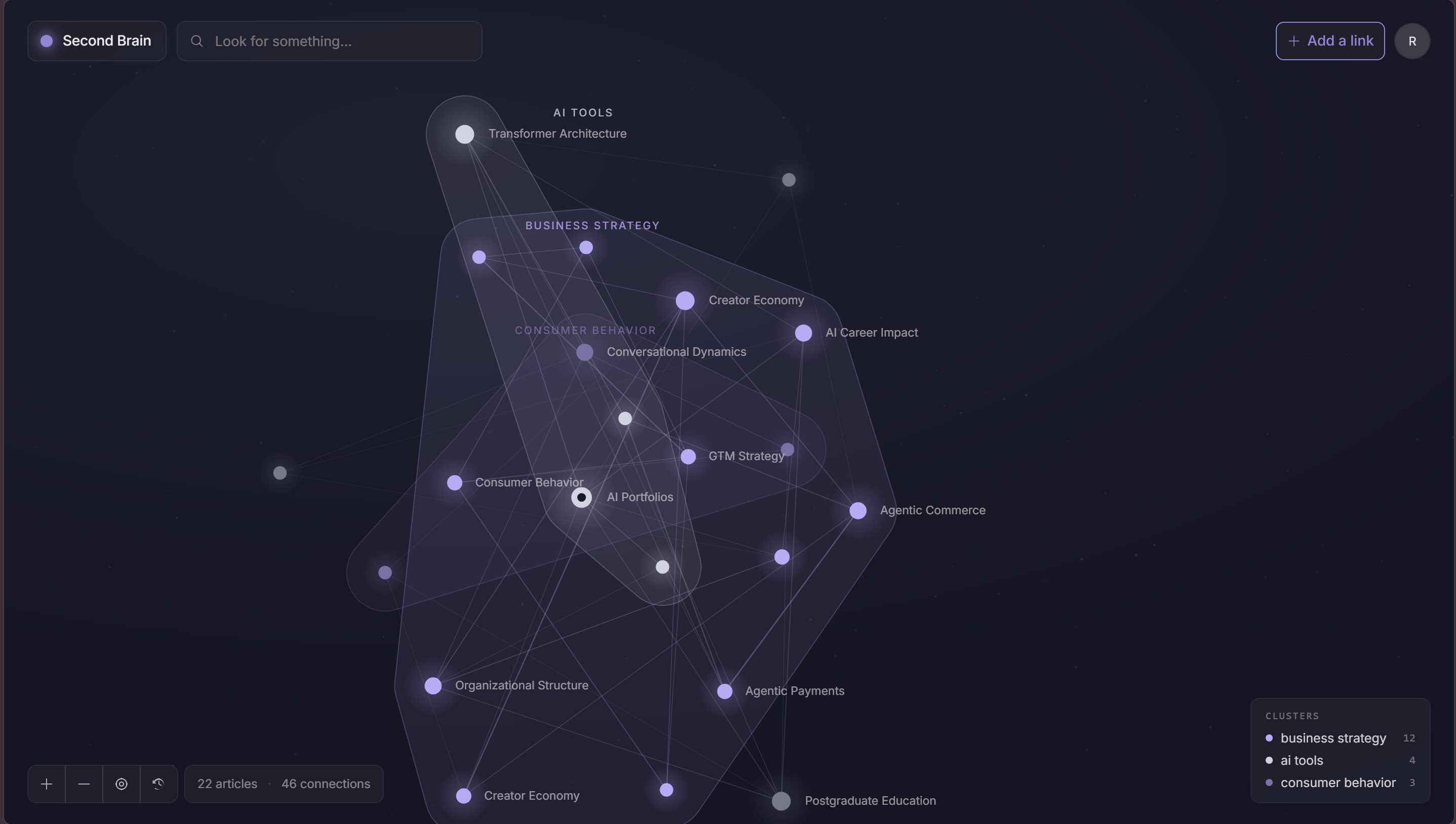
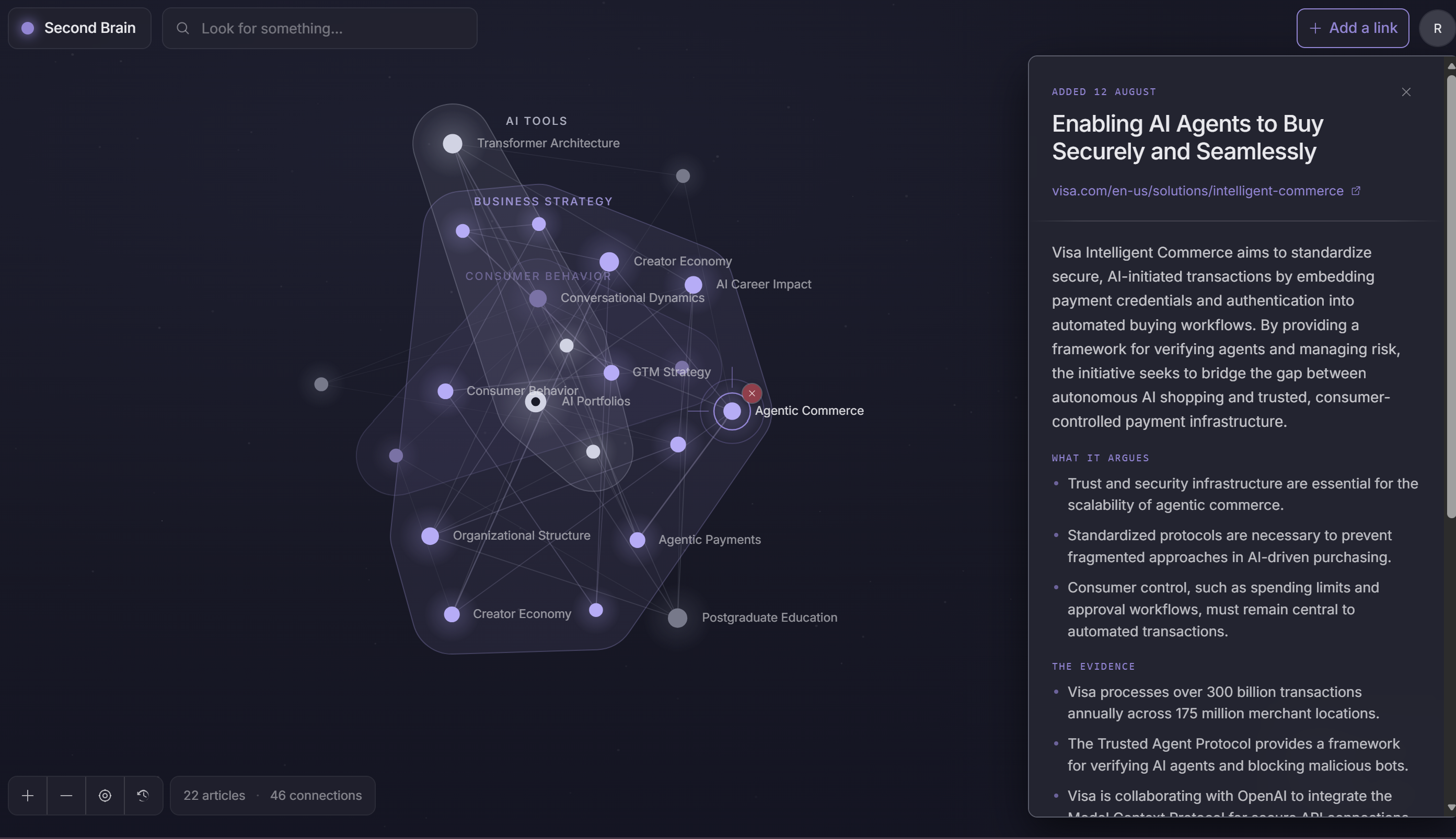
A knowledge graph of everything you save — summarised, tagged, connected and resurfaced — behind a one-click capture.
01Target customer
Sarthak, the Scrambled Ambitious Learner
Mid-20s to early-30s. High intent, high curiosity, low structural discipline. Wants to learn quickly and believes AI tools can accelerate them, but gets lost in the volume of options and ends most sessions with more tabs open than lessons completed.
The paradox
High intent + lots of tools = low progress + poor recall.
02Where value leaks
Current user journey
Saves land in bookmarks, WhatsApp and notes. The plan lives in the head. When the content is needed again, it can't be found or recalled, and the loop restarts: high effort, low clarity.
Core problem — the collapse between “saved” and “resurfaced”
Learners save aggressively across many platforms (high save intent), but most saved content is hard to find or never resurfaces (low retrieval). The result is decision fatigue, wasted effort and lost learning momentum.
6+
sources searched in parallel (LLMs, YouTube, blogs, forums…)
50+
links saved across tabs, bookmarks, WhatsApp, notes
<20%
return rate — saved content that is ever reused
Evidence from user interviews.
Problem hypotheses — Sarthak is most frustrated about…
01 · Confirmed
staying consistent
because there is no system that brings the right content back at the right time.
02 · Confirmed
not finding what they saved
because their saved content is unstructured and unconnected.
03 · Not confirmed
figuring out what to learn next
because they lose too much time evaluating and switching sources.
03Solution hypothesis
A connected learning system that captures, organizes and brings back the right content at the right time so that nothing you read gets lost.
1. Upload
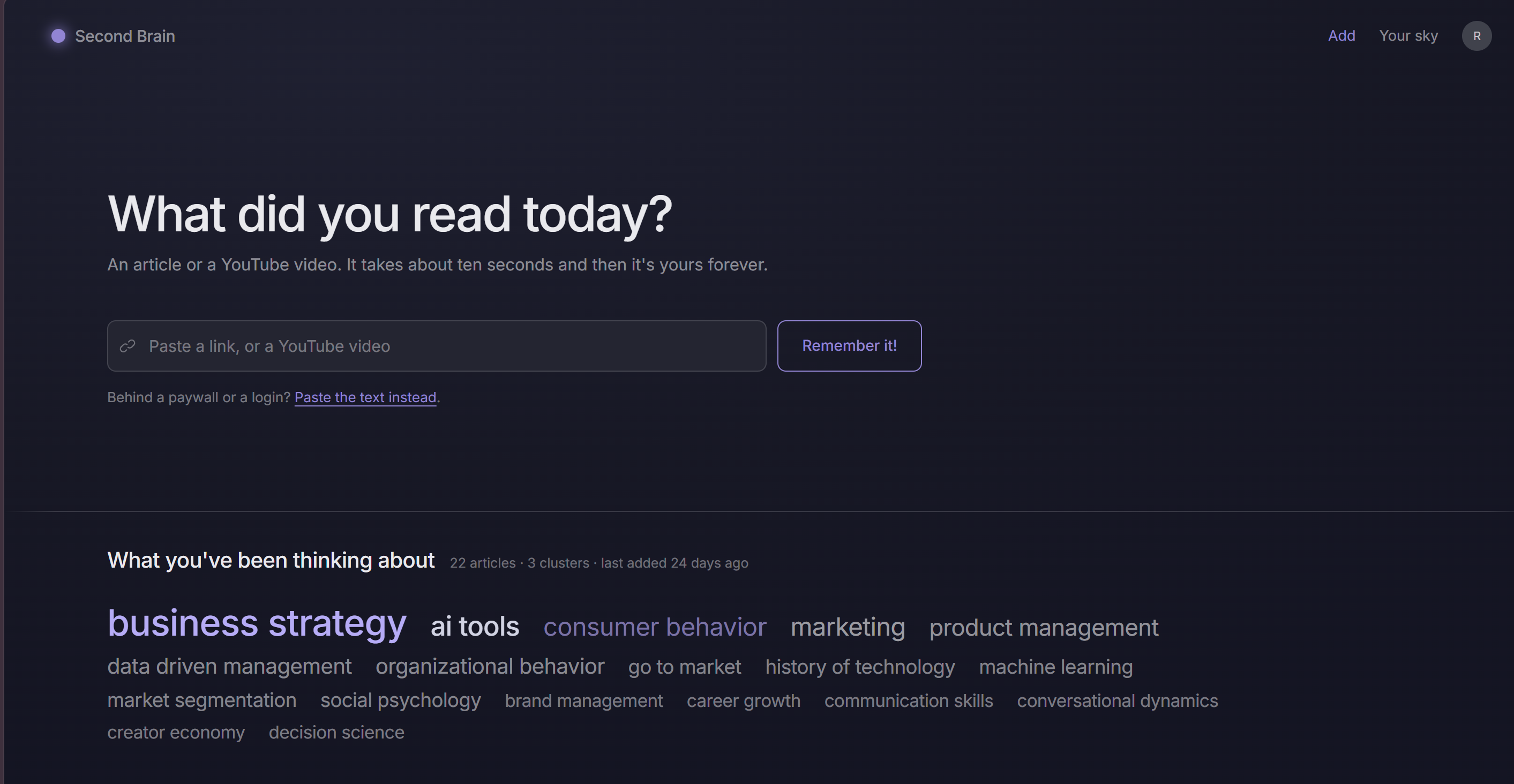
One-click upload from anywhere (links, videos).
2. Summarize
AI summary + auto-labeling for quick context.
3. Organize
Connected topics and tags to create structure.
4. Retrieve
Semantic search + filters to find what you need, instantly.
5. Reinforce
Nudges bring back what you saved weeks ago.
What testing told us
Capture friction, not intent, is the binding constraint.
One click, and saving becomes reflexive.
Retrieval has to run on the idea, not the source.
People find items by describing the concept.
A stated learning goal makes the product sticky.
People came back to save with no goal set.
04What we shipped
Scope was cut by customer delight (Kano) against implementation complexity: ship what makes saving reflexive and retrieval useful, defer what is costly or not yet proven.
Open the live MVP ↗In MVP 1
- —Login
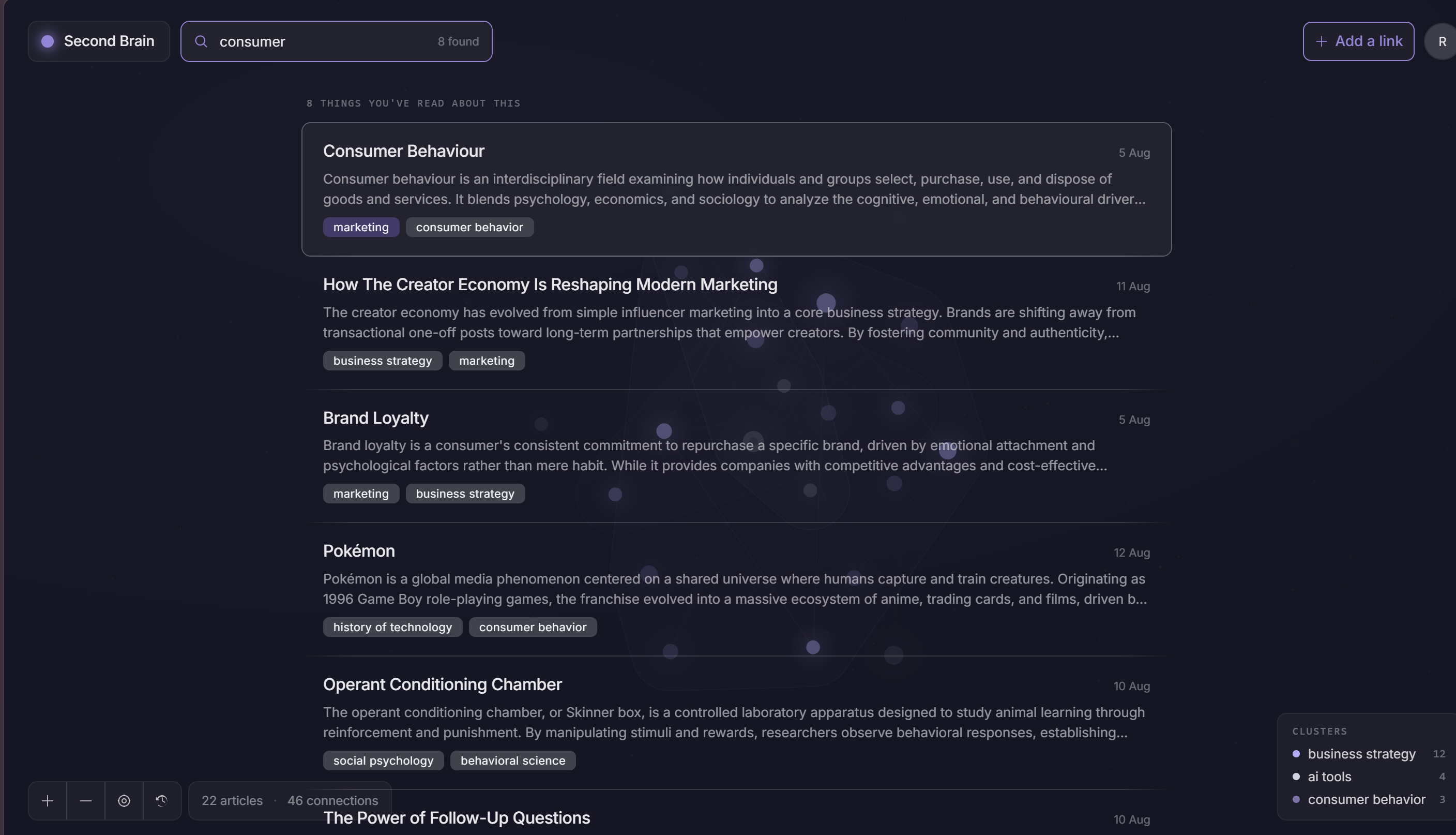
- —List of all reads
- —Search
- —Add link on web app
- —AI summary
- —Extension capture
- —YouTube capture
- —Visualise & recommend
Deferred
- —Notes
- —PDF capture
- —Image capture
- —Import library
- —LLM chat
- —Community
Our moat
A graph that compounds
Value compounds with the library.
Switching cost accrues
An earned graph doesn't transfer.
Unoccupied position
No direct substitute does it all.
05How we measure value
North star
Weekly Recall Rate
The % of active users who reopen at least one previously saved item in a given week.
It is the single behaviour both sides need: the user gets confident recall, and the business gets the returning usage that compounds the data moat.
Derived via the GAME framework
G
Goals
Confident recall (user) × retention that feeds the moat (business).
A
Actions
Save, reopen, search, note — mapped to acquisition, activation, retention.
M
Measures
Instrumented events in PostHog, reused rather than reinvented.
E
Evaluate
Each metric checked for validity, sensitivity, actionability and gaming risk.
Metric portfolio
LeadLeading (predictive)LagLagging (outcome)GuardGuardrail
Acquisition
How they arrive
- lagSign-ups (unique users)
- leadTop referrers by channel
- lagSessions & pageviews
Activation
First meaningful use
- leadSign-ins (daily)
- leadAdd-link opens / user
- lagArticles submitted
- leadVisit → interaction funnel
Engagement
Depth in each feature
- leadSky zooms / user
- leadNode article opens / user
- leadTimeline opens / user
- leadSearch MRR (relevance)
- leadSummary scrolls / user
- lagArticles read (unique)
Retention
Coming back over time
- lagDAU / WAU / MAU
- lagWeekly retention (cohort)
- lagGrowth accounting
- lagSign-in → add-link retention
- lagUser paths from login
Guardrails
Quality & reliability
- GuardArticle failures
- GuardZero-result searches
- GuardSearch click rank distribution
- GuardOriginal vs summary trust ratios
From signal to action
Article revisits
% of active users who reopen a previously saved article in a week. Are people using their second brain, or just hoarding?
Trigger
Weekly revisit rate below 30% of active users, or new-adds outpace revisits by more than 4×.
PM action · possible RCA
- — Check search MRR and zero-result rate: is search failing to surface old saves?
- — Look at Timeline and Node engagement: is discovery of older articles broken?
- — Ship resurfacing prompts (“you saved this X weeks ago”) and better ranking.
Article failure count
Failed article loads and processing attempts. The moment ingestion breaks, so does the product.
Trigger
Failures spike above the paywall-driven baseline (~7d rolling avg), or exceed 5% of submissions.
PM action · possible RCA
- — Break failures down by source domain: is a publisher blocking us?
- — Check parser logs and recent deploys for ingestion regressions.
- — Watch session replays of failed users: retry, abandon or churn?
Metric thresholds
| Metric | Type | Limit | Alert when |
|---|---|---|---|
| Weekly retention (W1) | lag | ≥ 25% | Drop > 5% WoW, or below floor for 2 weeks |
| Article revisit rate (weekly) | lead | ≥ 30% | Below floor for 2 consecutive weeks |
| Search MRR | lead | ≥ 0.60 | 7-day rolling avg below floor |
| Zero-result search rate | guard | ≤ 15% | Above ceiling on any given day |
| Search → article CTR | lead | ≥ 50% | Below floor for 3+ days |
| Add-link opens / user (weekly) | lead | ≥ 3 | Below floor for 2 consecutive weeks |
| Article failure rate | guard | ≤ 5% | Above ceiling on any given day |
| Signup → add-link retention (D7) | lag | ≥ 20% | Weekly cohort below floor |
06AI evals: thresholds & triggers
A number only matters if crossing it triggers a real action. These are the lines each AI eval is watched against, and what happens the moment one is crossed.
Summary quality
< 3%
Ceiling · contradiction rate
Check whether the summary directly contradicts the source using NLI models (SummaC / FactCC / AlignScore, shortlist to compare).
If crossed → Pause AI summaries on new saves, fall back to raw extracted text, trigger a model review.
Protects trustTags accuracy
< 15%
Ceiling · miss rate, hit@3
Set tighter than usual because there is no manual correction path yet, so a wrong tag is currently permanent. hit@1 miss rate is also watched at < 25%.
If crossed → Stop auto-finalizing tags and add a lightweight accept/reject step at save time as an interim safety valve.
Protects the graphNode distance / similarity
< 25%
Ceiling · AI-judge disagreement
With no human evaluation capacity, measure whether Gemini's similarity ranking agrees with an independent AI judge.
If crossed → Periodic manual spot-check by the team, and alter the internal formula that gauges similarity.
Protects relevanceSearch / ranking
≥ 0.5
Floor, not ceiling · MRR
Analyse the rank of the results users pick, to see which results get chosen most.
If crossed → Trigger a head-to-head A/B between text-match and embedding-based ranking.
Protects findability07Monetization
Freemium: 30 articles free, then paid features and a higher article limit at ₹49 / month. Storage drives the major costs, so the size of the free tier decides whether the model works.
| ₹ / month | S1 · 20 free | S2 · 30 free | S3 · 50 free | S4 · unlimited |
|---|---|---|---|---|
| Paying users | 2,000 | 2,000 | 2,000 | 1,000 |
| Net revenue / month (₹) | 74,497 | 74,497 | 74,497 | 37,248 |
| Contribution per paying user (₹) | 29.82 | 29.82 | 29.82 | 29.82 |
| Less: free-cohort cost (₹) | (30,195) | (40,309) | (50,531) | (84,332) |
| Contribution after free tier (₹) | 29,436 | 19,322 | 9,100 | (54,517) |
| Operating profit / month (₹) | 27,527 | 17,413 | 7,191 | (56,426) |
| Operating margin | 37% | 23% | 10% | (151%) |
| Headroom (funded ÷ actual free users) | 1.97x | 1.48x | 1.18x | 0.35x |
| Break-even conversion rate | 2.0% | 2.6% | 3.4% | 5.7% |
Scenario 2 (current plan) highlighted. Paying users at 4% conversion; S4 at 2%.
2.6% break-even conversion
One paying customer funds 35.5 free users against 24 actually carried (1.48x headroom). The plan runs at 4%. Unlimited free (S4) loses money at any realistic conversion.
Sensitivity — Scenario 2 operating profit (₹ / month), conversion × price
| Conversion | ₹29 | ₹39 | ₹49 | ₹59 |
|---|---|---|---|---|
| 2% | (28,445) | (20,844) | (13,242) | (5,640) |
| 3% | (20,719) | (9,317) | 2,086 | 13,488 |
| 4% | (12,994) | 2,210 | 17,413 | 32,617 |
| 5% | (5,268) | 13,737 | 32,741 | 51,745 |
| 6% | 2,458 | 25,263 | 48,068 | 70,874 |
08Go-to-market
Product-led growth: reach readers where they already read. The 30 free articles are the acquisition engine, and every channel funnels into the free tier.
PLG loop — the free tier does the selling
Reading platforms
Browser extension plus one-click import for Medium, Substack, Pocket and Kindle highlights. The article a young professional was already reading lands in Second Brain in one tap.
Organic distribution — near-zero paid media
Campus & workplace blogs
Guest essays in student newsletters, department and society mailing lists, and early-career Slack / Discord communities. Ambassadors run one reading-workflow session per campus.
Target ≤ ₹11 per free signup
Ads on research websites
Paid placements around arXiv, SSRN, JSTOR and Semantic Scholar, plus retargeting on scholarly search. Bought on payback, not impressions.
Hard cap ₹300 CAC → 2.8x LTV/CAC
₹852
Lifetime contribution per paying user
₹11
Ceiling on cost per free signup
2.6%
Break-even conversion; plan runs at 4%
35.5
Free users funded by one paying customer
09Ethical considerations
Ownership. Storage is secure and private so users feel free to save and organise anything. Users keep full ownership of their data; it is never sold, shared or repurposed.
Control. Users can delete any saved item, or their entire account, at any time, with no data retained after deletion.
Risk. The principal risk is surfacing politically or socially sensitive saved content at the wrong moment. An automatic guardrail suppresses push notifications for any content tagged as political or socially grey-area.
From “I saved it somewhere” to “here's what you saved, and how it connects.”
Every save makes the graph more valuable and harder to leave. That compounding library is the moat.